
Reviewed · AMSTERDAM WALKING TOURS
Amsterdam Highlights Small-Group Walking Tour
Amsterdam’s old center makes more sense when you connect its landmarks to the stories behind them. This small-group walk takes you from Beursplein to Dam Square, passing Centraal Station, the Chinese Quarter, Nieuwmarkt, the Jewish Quarter, Muntplein, and the Begijnhof along the way.
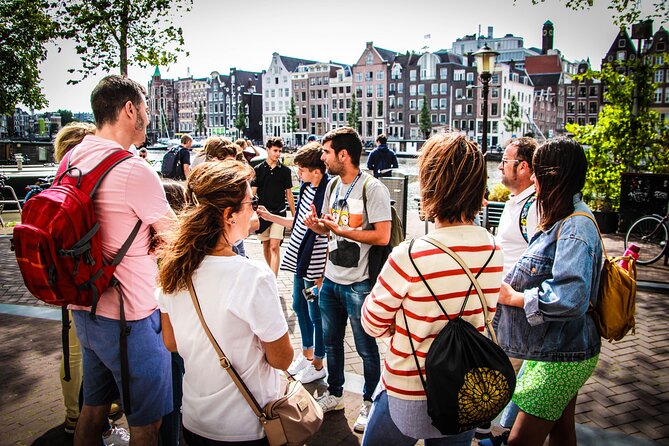
I like two things in particular: the group is capped at 10, which gives you a better chance of hearing your guide and asking questions, and the route mixes big sights with places that reveal more about daily life and difficult chapters of the city’s past. You can also add a one-hour canal cruise.
One caution: a small group does not guarantee a perfectly clear or well-paced tour. Some walks have been criticized for soft-spoken guides, long explanations in noisy spots, and a route that felt disjointed. Bring water, arrive ready to confirm the exact meeting spot, and speak up if you cannot hear.
What to know before you go

- Start at Beursplein: Meet near the Cafe Bistro and bull figure, where the guide is expected to carry a blue umbrella or an Amsterdam Guides & Tours tag.
- See the center on foot: The route links major squares and historic neighborhoods, ending at Dam Square.
- Keep the group small: The maximum is 10 people, a useful size for a city walk on busy streets.
- Plan for about 2.5 hours: The stated duration is approximate, with some walks taking around two hours and others closer to three.
- Choose the canal cruise option: The one-hour boat ride is included only if you select that option when booking.
- Expect a guide-led history lesson: Guides such as Jacob, Laura, Claire, Pia, and Ilya have led tours, though your guide will depend on the date.
A compact route through Amsterdam’s old center
At $24.08 per person, this is an affordable way to get an introduction to the center of Amsterdam. You are paying for a guide and a structured walk, not entrance tickets to museums or food and drink. The stops listed are public places, and admission is free.
The price makes the most sense if you are new to the city, have limited time, or want a human guide to connect the sights. A good guide can add context that a self-guided stroll may miss, from architecture and city history to stories about present-day life. You also get a chance to ask questions and collect suggestions for what to see next.
The tradeoff is that the experience depends heavily on the guide’s delivery. Several guides, including Jacob, Laura, Claire, Pia, and Ilya, have been praised for making history lively with humor, anecdotes, and practical suggestions. But other walks have felt too quiet, poorly paced, or hard to follow in crowded places. The group limit helps, but it cannot remove street noise or guarantee a particular style of guiding.
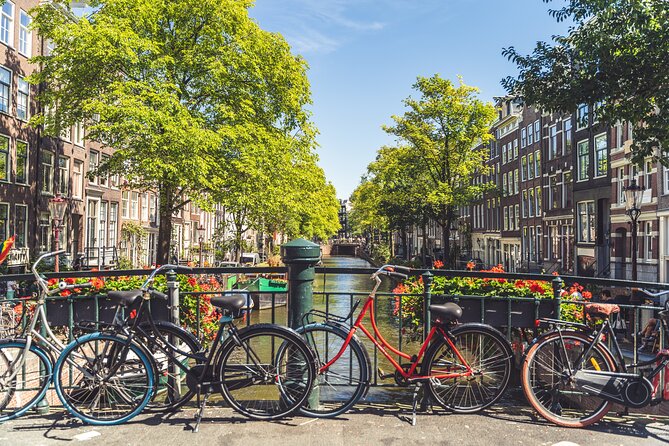
The route’s appeal is its variety. You move from the city’s transport hub into a Chinese neighborhood, a market square, a district marked by Jewish history, a central square, a quiet courtyard, and finally Amsterdam’s main civic gathering place. That gives you more than a string of postcard stops, though the time at each is brief.
More walking tours in Amsterdam:
- Anne Frank’s Story – Guided Walking Tour through Amsterdam
★ 5.0 · 11,619 reviews - Amsterdam: Life of Anne Frank and World War II Walking Tour
★ 4.8 · 10,467 reviews - Absolutely Amsterdam – the Essential Introductory Walking Tour
★ 5.0 · 3,629 reviews
Finding your guide at Beursplein
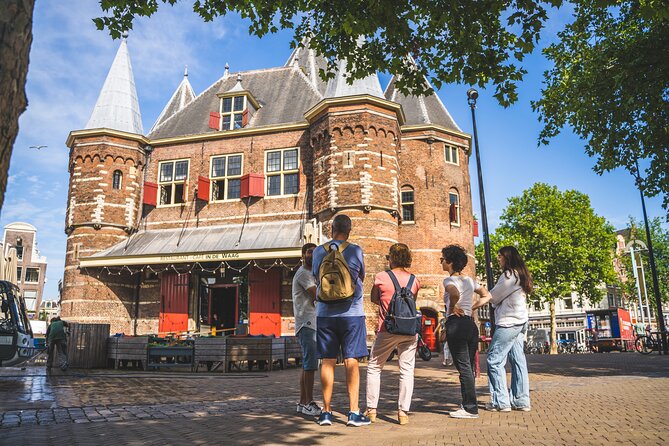
The walk begins at Beursplein, the square beside the stock exchange. The meeting instructions point to the area in front of the Cafe Bistro, next to a bull figure. Look for a blue umbrella or a tag carrying the Amsterdam Guides & Tours logo.
That detail matters in a busy central square where several groups may be gathering. The meeting point can be easy to miss if you expect the guide to be standing at a building entrance, so check the location carefully before setting off. The start is near public transportation, but getting to Beursplein is your responsibility.
The listed first stop is about 10 minutes, and the square serves as the opening scene for the walk. A brief introduction can help you orient yourself and understand why the stock exchange gives the square its name. If the guide begins a long talk amid traffic, construction, or other groups, it may be difficult to hear. Take a position close to the guide, and ask them to speak up or move if the sound is poor.
Centraal Station and the Chinese Quarter
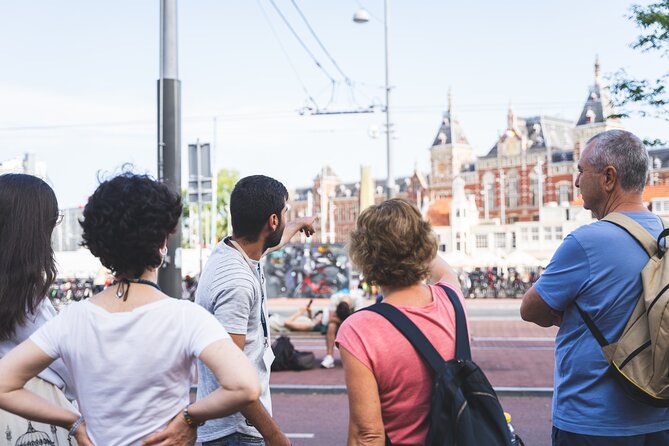
The next stop is Amsterdam Centraal, a major point of arrival and one of the city’s most recognizable buildings. Designed by Dutch architect Pierre Cuypers, it opened in 1889 and remains Amsterdam’s main railway station. Even if you have already passed through it, a guide can draw your attention to its design and role in the city.
The scheduled stop is short, around 10 minutes. Think of this as an introduction rather than an in-depth architectural visit. The group then walks through the Chinese Quarter, where the route includes Amsterdam’s Buddhist Temple. This shift from the monumental station to a neighborhood with a temple gives the tour some welcome texture. You get a glimpse of how the city’s center is not only a collection of old Dutch buildings.
The walk does not list a separate timed stop for the temple, so expect to see it as part of the route rather than spend a long stretch inside. If a particular building or detail catches your eye, ask your guide about it while the group is nearby. A small group makes that easier than a large coach tour, though narrow streets can still put people in single file.
Nieuwmarkt and the city’s older edges
Nieuwmarkt is scheduled for about 15 minutes. The name means new market, and the stop includes the historic San Antón Gate, near the Chinese Quarter. It is a useful place to picture the city beyond the grand squares: markets, neighborhood streets, and traces of earlier defenses all meet in this part of the center.
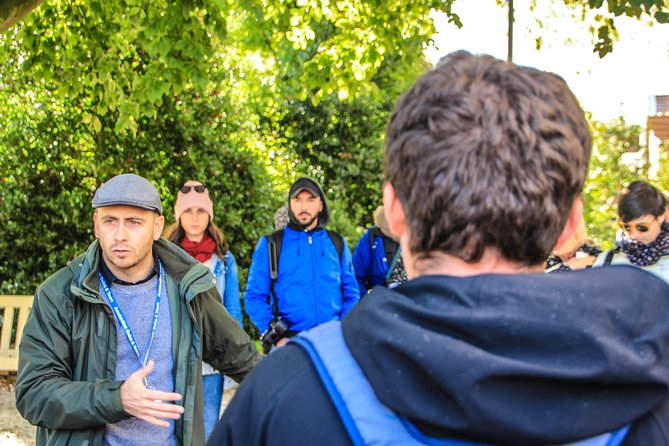
This is one of the stops where a guide’s storytelling can make a visible structure more meaningful. Rather than simply pass the gate, you can ask how it fits into Amsterdam’s past and what changed as the city grew. The exact amount of detail will vary, so if the tour moves on before you have had a chance to look closely, note the location and return later.
The timing is short enough that you should not expect a full history lesson at every landmark. The walk is designed to cover a broad range of places, and the guide has to keep the group moving. That balance is part of the value, but it also explains why a visitor hoping for deep detail at each stop may want to add independent visits afterward.
More small-group tours in Amsterdam:
- Amsterdam: Anne Frank Guided Small Group Walking Tour
★ 4.8 · 2,722 reviews - Amsterdam Small-Group Canal Cruise Including Snacks and Drinks
★ 5.0 · 2,526 reviews - Zaanse Schans Windmills, Clogs and Dutch Cheese Small-Group Tour from Amsterdam
★ 4.5 · 2,369 reviews - Amsterdam: Zaanse Schans 3-Hour Small Group Tour
★ 4.8 · 2,160 reviews
Jodenbuurt and the difficult history of the Jewish Quarter

The route continues into Jodenbuurt, Amsterdam’s Jewish Quarter, with about 10 minutes listed for the stop. The guide also discusses the neighborhood’s history during the Second World War. This is among the most important parts of the walk, and it changes the tone from architectural observation to remembrance.
A short city tour cannot do justice to the full history of the Jewish community or the losses of the war. Still, placing this subject within the streets and neighborhoods where it unfolded can give you a clearer sense of how the city’s past is part of its present. The guide’s sensitivity matters here. One account of a walk praised a guide for handling difficult subjects with care, but the quality and depth of the conversation will depend on who leads your tour.
If this history is a central reason for your visit, use the walk as an introduction rather than a substitute for a dedicated museum or memorial visit. The tour does not include museum admission, and the schedule moves on after a brief stop. You can ask your guide for further suggestions, as some guides have offered practical ideas for continuing your exploration.
Muntplein, flowers, and the Begijnhof
Muntplein is listed as a 10-minute stop. It is a well-known square associated with the flower market, adding a lighter, everyday note after the earlier discussion of wartime history. The tour description also mentions the nearby flower market as a point of interest, but it does not promise time for shopping or a detailed market visit.
From there, the route heads to Spui Square and the Begijnhof Gardens, with about 15 minutes assigned. The tour may also discuss the flower market or De Krijtberg Kerk in this part of the walk. The Begijnhof offers a contrast to the busy streets around it: a garden setting within the central city, where a pause can help break up the steady movement between squares.
This is one place where it pays to listen for the guide’s directions and stay with the group. The itinerary gives a short visit, not an extended stop, and it may not be possible to explore every nearby point in detail. If the Begijnhof is high on your list, ask whether there will be time to look around before the group moves on.
Dam Square and the end of the walk

The tour ends at Dam Square, the heart of Amsterdam, with around 15 minutes scheduled there. The guide points out the Royal Palace, Nieuwe Kerk, or National Monument. These landmarks make a fitting finish: the square is a place where civic life, major ceremonies, and the city’s history meet.
Ending here is practical as well as scenic. You finish in a central location, with a useful base for continuing your day. The tour does not include transfers from the meeting point, and it ends at Dam Square, so plan your next stop from there rather than expecting transport back to Beursplein.
Some guides have kept the walk lively with humor and architectural observations, while others have focused more on historical facts. The best version of this final stop is not just a list of buildings. Ask what the square means to the city today, or how its landmarks relate to the neighborhoods you have just crossed.
Optional canal cruise: a different view of the city
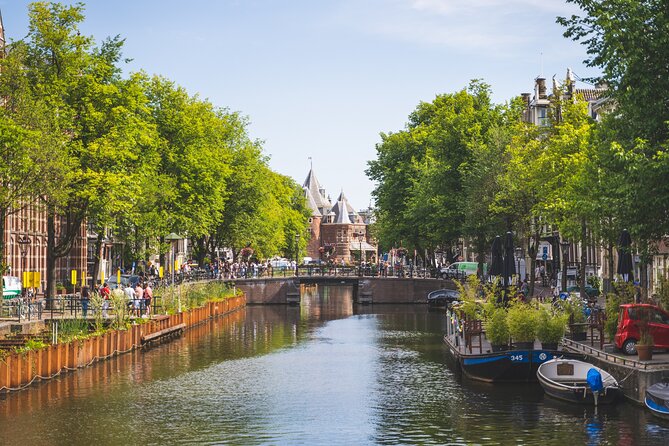
You can add a one-hour canal cruise to the walking tour. The cruise ticket is included only with the option selected at booking, so check your reservation details rather than assuming the boat ride comes with the base price. Food and drinks are not included.
The boat ride changes the pace after a few hours on foot. From the water, you get a different view of the city’s canals and streets, and it can be a pleasant way to rest while still sightseeing. One visitor described a walk that covered history from the 1600s through the Second World War and then finished with a relaxing cruise. That combination is a strong reason to consider the upgrade if you want both a ground-level introduction and time on the canals.
There have also been problems with cruise-ticket confusion. Make sure you have clear instructions for where and when to board, and keep the ticket or confirmation accessible. If the cruise is important to your plans, resolve any uncertainty before the walking tour ends rather than leaving it to chance at the dock.
What the small-group format can and cannot do
A maximum of 10 people is a real advantage on a walking tour. You are less likely to be lost behind a large crowd, and it is easier to ask a question or hear a guide who speaks clearly. Several guides have been described as funny and engaging, with names including Jacob, Laura, Claire, Pia, and Ilya appearing in accounts of past tours. Your guide may be someone else.
But a small group is not a promise of perfect sound or an orderly route. Amsterdam’s center can be noisy, and some streets are narrow enough to force the group into single file. A guide who speaks softly can become hard to hear, especially if the tour stops near traffic, construction, or a crowd. If you are struggling, say so early. Waiting until the end will not help you recover what you missed.
The tour’s organization may also vary. Some people have found it easy to follow and full of well-chosen stops, while others have felt that explanations ran long or that promised details never came later. You will get the most from it if you treat the walk as a broad introduction, stay near the guide, and ask direct questions when the route or commentary feels unclear.
Timing, comfort, and who will get the most from it
The advertised walk lasts about 2.5 hours, with an overall estimate of two to three hours. Individual stops are brief, and walking time between them makes up much of the experience. Leave room in your schedule, particularly if you have a timed museum visit afterward. One person’s tour began late, so avoid booking a close connection that depends on a precise finish.
Bring water, especially in warm weather. The walk covers a lot of central ground, and a past participant specifically advised carrying a bottle. Wear shoes suited to several hours on city streets, and be ready for a pace that includes frequent stops and starts. No special fitness requirement is stated, and most people can participate, but the experience is still a walking tour, not a seated overview.
This suits a first-time visitor who wants an efficient orientation, someone with only a day in Amsterdam, or anyone who enjoys hearing local stories alongside major sights. It is less suitable if you want long visits at each landmark, a guaranteed quiet setting, or a specialist-level treatment of wartime history. Children must be accompanied by an adult, and service animals are allowed.
Is the Amsterdam Highlights walk worth booking?
At about $24 per person, the walk is a good-value introduction if you want to understand how central Amsterdam fits together and prefer a guide to wandering on your own. The small group, broad route, and option to add a canal cruise are its strongest points. The mix of market streets, architecture, gardens, and difficult history gives the walk more substance than a quick photo stop circuit.
I would book it early in a short stay, ideally when you can keep the rest of the day flexible. Go in expecting an overview, not a specialist tour, and choose the cruise option only if you want the extra hour and have clear boarding details. If you value a lively guide, ask questions, stay close enough to hear, and speak up if the pace or sound is not working for you. For a first look at the city center, it is a sensible way to get your bearings.
FAQ
How long does the walking tour last?
Plan for about 2.5 hours. The stated duration is approximate, ranging from two to three hours.
Where does the tour start and finish?
It starts at Beursplein and ends at Dam Square. At Beursplein, look near the Cafe Bistro and bull figure for a blue umbrella or an Amsterdam Guides & Tours tag.
Is the canal cruise included?
A one-hour canal cruise is included only if you select that option. Check your booking details for the cruise information.
How large is the group?
The maximum group size is 10 travelers.
Is food or drink included?
No. Food and drinks are not included.
Can children and service animals join?
Children must be accompanied by an adult, and service animals are allowed.
Added lately in Amsterdam
- Private Amsterdam Red Light District tour with food tastings★ 5.0 · 6 reviews
- Anne Frank and Jewish Culture Private Walking Tour in Amsterdam★ 4.5 · 38 reviews
- Amsterdam: Van Gogh Museum Entrance and Guided Tour★ 3.5 · 3 reviews
- Private Amsterdam WW2 walking tour★ 4.5 · 15 reviews
- Amsterdam: Guided Red Light District and City Walking Tour★ 4.5 · 15 reviews
- 2-Hour Private Anne Frank Walking Tour with Drink★ 5.0 · 3 reviews
- Amsterdam Photography Masterclass – Private Photography Lesson★ 5.0 · 32 reviews
- Private Amsterdam Red Light District tour including sex museum★ 4.5 · 75 reviews
Amsterdam Walking Tours, compared.

Anne Frank’s Story – Guided Walking Tour through Amsterdam
Read our review →
Life of Anne Frank and World War II Walking Tour
Read our review →
Absolutely Amsterdam – the Essential Introductory Walking Tour
Read our review →

Anne Frank Walking Tour – Guided in EN/DE/IT/ES
Read our review →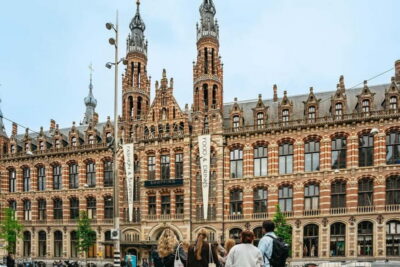

Anne Frank Walking Tour Amsterdam Including Jewish Cultural Quarter
Read our review →Browse the lists this tour appears in