
Reviewed · AMSTERDAM WALKING TOURS
Walking Tour about Golden Age Architecture, private local guide
Amsterdam’s Golden Age is written into the city’s street fronts: grand merchant houses, steep warehouse gables and small carved stones that tell you who once lived or worked behind the brick. This private walk connects those clues to the people and trade that shaped the canal belt. I like that you get one-on-one time with a local guide, and that the route covers both major landmarks and details you could easily pass without noticing.
I also like the mix of architectural talk and human stories, including the link between De Dolphijn and the captain in Rembrandt’s The Night Watch. The main consideration is the pace: the tour lasts about 90 minutes, with long stretches on foot and no mobility aids available. If standing or walking for that long is difficult, this may not be the right fit.
- A private route through the canal belt: Your group has the guide to itself, so you can ask questions as you go.
- Architecture with practical context: Hear how Amsterdam’s buildings were designed for trade and built on soft, marshy ground.
- Nine stops in about 90 minutes: The route runs from the Royal Palace area to Westerkerk, with time in the Jordaan.
- Small details matter here: Facade stones, hoisting beams and distinct gable styles help decode the streets.
- A personal guide is part of the value: Anna is named in several tour accounts and is praised for clear explanations and a friendly, flexible manner.
Reading Amsterdam’s façades, one street at a time
This is an architecture walk, but it is not only about naming styles. The tour links a building’s shape and decoration to the wealth, work and daily life that produced it. You’ll hear how Amsterdam’s growth as a 17th-century trading center left its mark on the city, from prestigious canal houses to practical warehouses.
That approach is useful if you have already wandered the canals and wondered why one house has a sculpted front while the next is narrow and plain. Instead of treating the streets as a pretty backdrop, your guide points out the choices built into them: how merchants displayed status, how goods moved between boats and upper floors, and how the city’s difficult ground affected construction.
The tour is private, in English, and lasts about an hour and a half. The stated price is $73.59 per person, with group discounts available. Because it is private, you are not sharing the guide’s attention with a larger group. That can be especially worthwhile on a topic where questions and close observation make the walk more rewarding.
Starting near Dam Square and the Royal Palace
The meeting point is the Royal Palace Amsterdam at Nieuwezijds Voorburgwal 147. The opening stop is Dam Square, a short introductory look at the city’s rise as a global trade hub during the Dutch Golden Age. The square gives your guide a useful place to set the scene before the buildings start telling their own stories.
The palace itself was first built as Amsterdam’s town hall, a public building meant to express the city’s power and prosperity. You’ll hear how it later became a royal residence and learn about its Dutch Neoclassical style, materials and construction. The engineering story is especially worthwhile: the building had to be raised on challenging clay and marshy ground.
You spend about ten minutes at the palace, so expect an exterior-focused discussion rather than an extended visit inside. Admission is not part of the tour, and the palace is described as a stop for architectural and historical context. If you want to see its interior, you’ll need to plan that separately.
More walking tours in Amsterdam:
- Anne Frank’s Story – Guided Walking Tour through Amsterdam
★ 5.0 · 11,619 reviews - Amsterdam: Life of Anne Frank and World War II Walking Tour
★ 4.8 · 10,467 reviews - Absolutely Amsterdam – the Essential Introductory Walking Tour
★ 5.0 · 3,629 reviews
Canal houses that signal wealth and ambition
Huis Bartolotti offers a clear contrast with the palace. This red-brick canal house has large windows and sandstone sculptural details, with an ornate façade that hints at its original owner’s wealth and trading links with Italy. The stop is brief, about five minutes, but a guide can help you read the front as more than decoration.
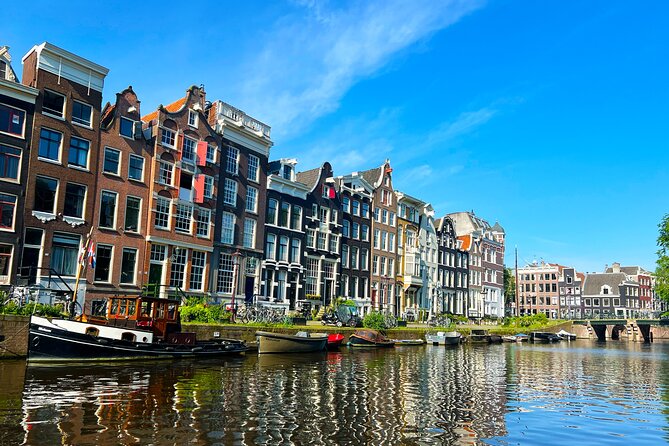
At Torensluis, the broad bridge becomes a viewing platform for four different façade designs associated with Amsterdam’s merchant class. Here you can compare the ways Dutch builders adapted Baroque features, and spot the city’s famously crooked houses. The leaning forms make for good photographs, but the tour gives them context too: Amsterdam’s soft ground has shaped the appearance of its buildings.
De Dolphijn adds a human connection to the architectural tour. Its name refers to the dolphin, a symbol of wealth, and the house was once owned by Frans Banning Cocq, the captain depicted in Rembrandt’s The Night Watch. That link makes the building easier to remember, and it ties the canal belt’s prosperity to a figure familiar from one of the Netherlands’ best-known paintings.
From the Lutheran dome to Prinsengracht’s warehouses
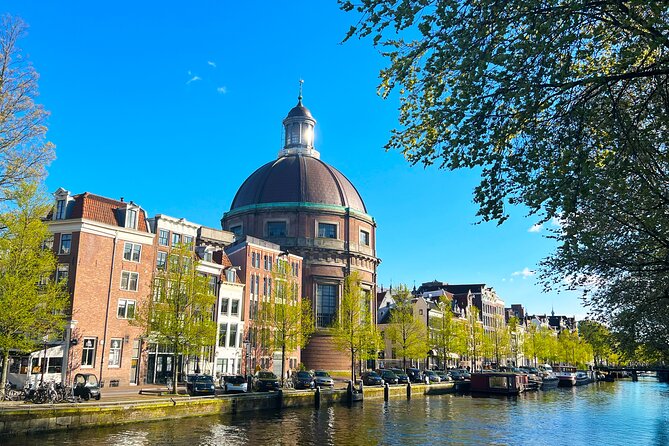
At the Ronde Lutherse Kerk, the focus shifts from merchant houses to a domed church. The guide discusses domes as a major architectural achievement of the Renaissance period. The scheduled stop is only about five minutes, so think of it as a compact architectural pause rather than a full church visit.
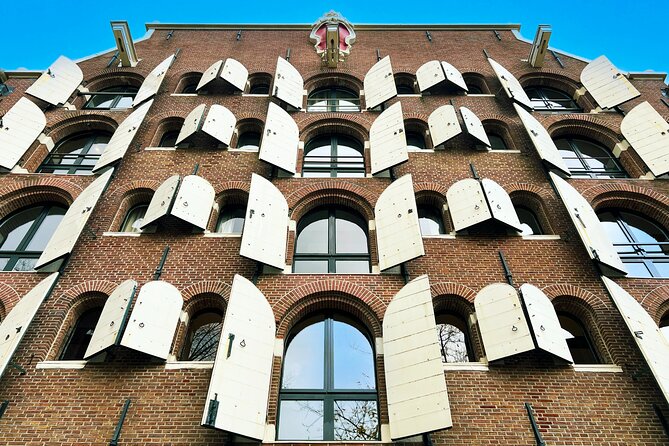
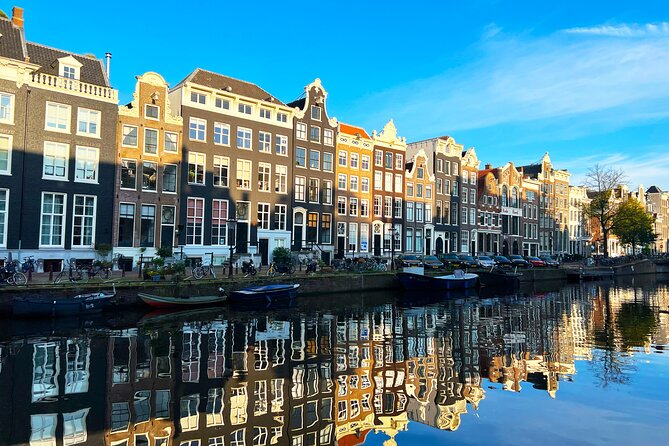
Prinsengracht brings the route back to the working side of the canal belt. Its warehouses were built to handle commerce, with tall, steep gables, large windows and wooden hoisting beams at roof level. Those beams helped lift heavy goods from boats into the buildings, a practical feature that also gives the canal fronts much of their familiar outline.
The contrast is the point: some canal houses announce a family’s status, while warehouses put function first. Their comparatively plain exteriors still speak of wealth through their scale and position. I like that this stop helps you see the canal not simply as scenery, but as part of the city’s transport and trading system.
Facade stones tell stories in the Jordaan
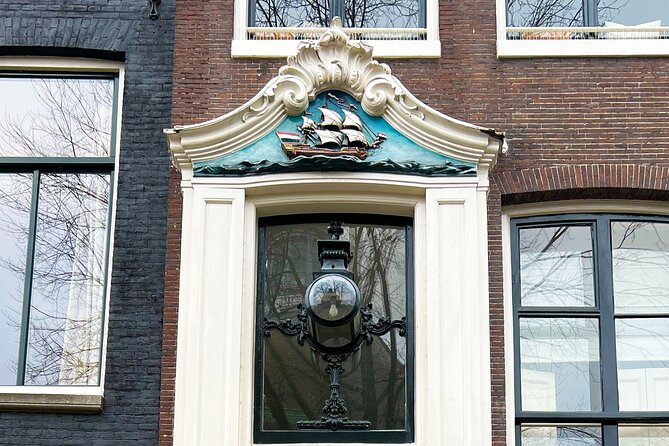
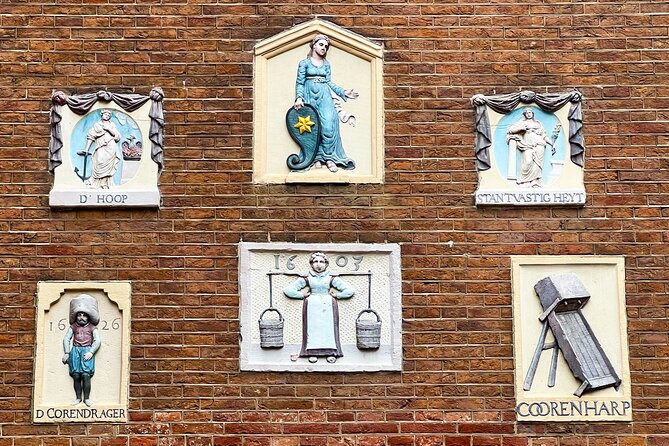
The Jordaan section gets the longest single stretch of the tour, about 20 minutes. In the 17th century, this neighborhood mixed homes, shops and workshops, with narrow canals and compact rows of houses. It developed as a district for craftsmen and laborers, giving the walk a useful counterpoint to the grander merchant façades elsewhere.
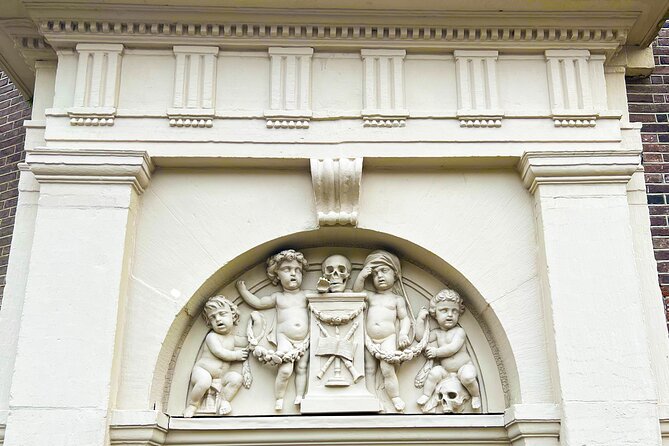
The focus here is on gevelstenen, or facade stones: small carved plaques set into building fronts. Some identify a trade or tell you how a building was used; others preserve a detail about the people who lived or worked there. They turn a street into a kind of open-air record, especially when you know what to look for.
This is the section where a local guide can make the biggest difference. Anna is described as someone who knows the canal neighborhood well and can connect architectural features with the area’s history and social life. The value is not just in being told what a carving means. It is learning to scan the next street yourself for clues.
The Jordaan stop also offers time to ask questions. Anna’s approach is described as patient and accommodating, with room for photo stops and questions along the way. If you like to pause over a detail or ask how Amsterdam developed beyond the buildings themselves, a private format makes that easier than keeping pace with a large group.
More private tours in Amsterdam:
- Rijksmuseum Amsterdam Small-Group Tour with Private Upgrade
★ 4.5 · 1,547 reviews - Van Gogh Museum Tour Reserved Entry Semi Private
★ 5.0 · 1,437 reviews - Private Amsterdam Red Light District and Coffee Shop Tour
★ 5.0 · 763 reviews - Anne Frank and Jewish Quarter Amsterdam Private Walking Tour
★ 5.0 · 684 reviews
Ending at Westerkerk near the Anne Frank House
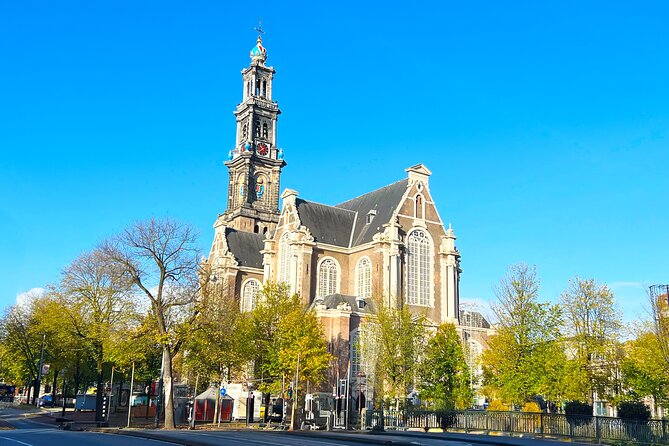
The walk ends at Westerkerk, on Prinsengracht beside the Anne Frank House. The church was built for Amsterdam’s growing Calvinist population, and its large, airy interior and restrained design reflect that tradition. The tour’s five-minute stop is a brief look at the church’s role and exterior, rather than a long visit inside.
Westerkerk’s spire rises 85 meters above the Jordaan and was completed in 1638. Its imperial crown has long served as a symbol of Amsterdam’s status, while the tower clock’s chimes have marked the hours for centuries. The bells also have a place in Anne Frank’s diary, giving the sound a personal connection to the nearby house.
Rembrandt is another name tied to the church: he is buried there. That makes Westerkerk a fitting final stop for a walk that connects architecture with the people who shaped Amsterdam’s culture. Since the tour finishes near the Anne Frank House, you can continue sightseeing in the area afterward, though the tour does not include admission to either site.
What a private guide adds to the walk
The tour’s strongest feature is its personal scale. It is reserved for your group, so you can ask about a façade you noticed earlier, request more detail on a building style, or take time for photographs without trying to catch up with a crowd. That freedom is particularly useful on a walking tour where many of the best clues are small.
Anna is the guide named in several accounts of this experience. Her strengths are presented as clear explanations, a friendly manner and the ability to make architecture accessible without reducing it to a list of dates and styles. She also answers questions about Amsterdam and can offer recommendations for further sightseeing, which may help you make better use of the rest of your stay.
The route is designed to show many notable buildings in a short period. That means you will not spend a long time at any single stop: most last five to ten minutes, with the Jordaan receiving about 20. If you want a long interior visit or a slow, unhurried study of each structure, this format may feel brisk. If you want a well-framed introduction that helps you understand what you see on later walks, the pace makes sense.
Is $73.59 per person a fair price?
At $73.59 per person, this costs more than a self-guided walk, and it is worth weighing what the extra money buys. You are paying for a private guide and a focused route that links buildings to Amsterdam’s trade, engineering and social history. The guide’s interpretations are the main added value: without them, a facade stone or hoisting beam can be easy to overlook.
The price may be easier to justify for a small group, particularly since group discounts are offered. The tour’s 90-minute length also suits a busy schedule: you can get an introduction to the Golden Age architecture without setting aside half a day. Bottled water is not included, so bring your own if you want some during the walk.
The experience currently has a 4.9 rating from 15 ratings, and all listed respondents recommend it. That is a strong signal, though the sample is small. The repeated praise focuses on Anna’s explanations, personal attention and the way she makes architectural details easier to notice. Those qualities align with what this tour is built to do.
Who should book this Amsterdam walk?
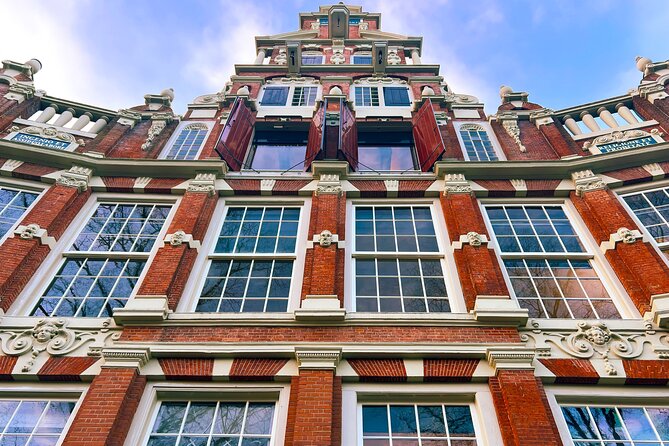
I’d choose this tour if you enjoy architecture, local history or simply want more from the canal belt than a photo stop. It also suits a first visit: the route gives you a quick orientation to central Amsterdam and leaves you with details to look for as you explore on your own. The focus on both major landmarks and lesser-noticed features makes the walk feel more specific than a general city overview.
It is also a good fit if you like asking questions. A private guide can adjust the conversation to your interests, and the tour’s accounts describe Anna as happy to answer questions and allow time for photos. You do not need to be an architecture expert. The explanations are intended to make the buildings understandable, not to test your knowledge of style names.
Think carefully about the walking requirement. The tour involves roughly 90 minutes of walking and standing, and it is not recommended for people who use a walker or have difficulty remaining on their feet. Mobility aids are not available. If that describes you, contact the provider before booking to confirm whether the route can work for your needs.
Should you book?
Book this if you want to understand why Amsterdam’s canal houses, warehouses and churches look the way they do, and you value a private guide who can answer questions. The route is concise, the subject is distinctive, and the link between architecture and everyday city life gives you something useful to carry into the rest of your visit.
Skip it if you need a seated experience, want substantial time inside the buildings, or prefer to explore at your own pace without a guide. For everyone else, this is a practical way to turn a pleasant canal walk into a more informed one.
FAQ
How long does the tour last?
It lasts about 1 hour and 30 minutes.
Is this a private tour?
Yes. Only your group participates.
What language is the tour offered in?
The tour is offered in English.
Where does the tour start?
It starts at the Royal Palace Amsterdam, Nieuwezijds Voorburgwal 147, 1012 RJ Amsterdam.
Where does the tour end?
It ends at Westerkerk, Prinsengracht 279, near the Anne Frank House.
How much does the tour cost?
The listed price is $73.59 per person. Group discounts are available.
Is admission to the Royal Palace included?
No admission ticket is included. The stop is for discussion of the palace’s history and architecture.
Is bottled water included?
No. Bottled water is not included.
Is the tour suitable for someone who has trouble walking?
The tour is not recommended for people who use a walker or have trouble walking and standing for 1.5 hours. Mobility aids are not available.
Added lately in Amsterdam
- Amsterdam: Van Gogh Museum Entrance and Guided Tour★ 3.5 · 3 reviews
- Private Amsterdam Red Light District tour with food tastings★ 5.0 · 6 reviews
- Anne Frank and Jewish Culture Private Walking Tour in Amsterdam★ 4.5 · 38 reviews
- Private Amsterdam WW2 walking tour★ 4.5 · 15 reviews
- Amsterdam: Guided Red Light District and City Walking Tour★ 4.5 · 15 reviews
- 2-Hour Private Anne Frank Walking Tour with Drink★ 5.0 · 3 reviews
- Amsterdam Photography Masterclass – Private Photography Lesson★ 5.0 · 32 reviews
- Private Amsterdam Red Light District tour including sex museum★ 4.5 · 75 reviews
Amsterdam Walking Tours, compared.

Anne Frank’s Story – Guided Walking Tour through Amsterdam
Read our review →
Life of Anne Frank and World War II Walking Tour
Read our review →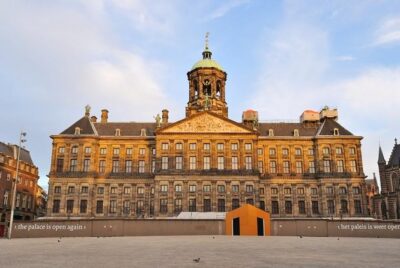
Absolutely Amsterdam – the Essential Introductory Walking Tour
Read our review →

Anne Frank Walking Tour – Guided in EN/DE/IT/ES
Read our review →

Anne Frank Walking Tour Amsterdam Including Jewish Cultural Quarter
Read our review →Browse the lists this tour appears in