
Reviewed · AMSTERDAM JEWISH HISTORY TOURS
Amsterdam in World War Two Cycle Tour
Amsterdam South holds wartime stories that are easy to miss from a tram window. On this small-group bike tour, you ride between former Nazi offices, resistance sites, places tied to deportations, and the home of Anne Frank’s family before they went into hiding.
I like two things in particular: wartime photos are matched to the exact places you visit, and the group is capped at six, so there is room to ask questions. Guide Rudy was born and raised in the area, and Peter is also named as a guide. One consideration: you need to be comfortable cycling, and the details do not clearly say whether a bike is supplied.
The route covers quieter streets beyond the central tourist circuit, giving you a broader view of the occupation than a walking tour can manage. Expect about two hours and 30 minutes to three hours and 10 minutes, including a short café stop.
- Merwedeplein connects the Frank family’s former home with the story of Anne Frank’s diary.
- Museumplein reveals how German forces turned a familiar square into a wartime stronghold.
- Small group, maximum six: easier to hear the guide and discuss difficult history.
- Historical photos help you compare wartime scenes with today’s streets.
- Practical point: the tour is in English, starts at 11:00 am, and costs $66.09 per person.
Cycling Amsterdam South’s wartime streets
The central idea is simple and effective: instead of hearing about occupation-era Amsterdam in a museum room, you cycle through the neighborhoods where its events unfolded. Several stops are ordinary-looking corners or apartment blocks. That contrast is the point. A quiet street can conceal a former Gestapo office, a house tied to resistance work, or the route taken by people arrested in a roundup.
You cover more ground than you could on foot, and the route’s focus on the south of the city takes you away from the most congested central streets. Cycling is not just transport here. It helps connect sites spread across several neighborhoods, while making it easier to see how close some of them were to one another.
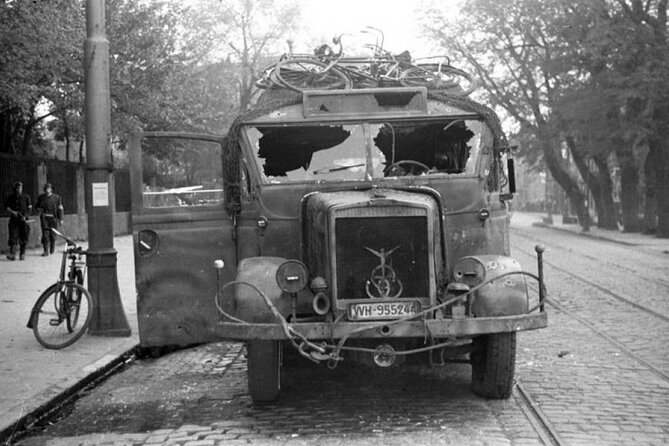
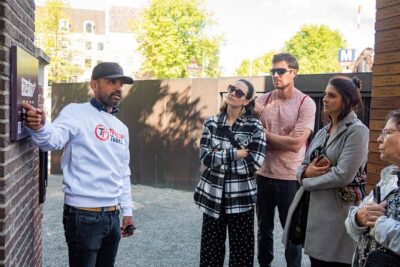
Your guide uses historical photos to show what a location looked like during the occupation. That visual comparison gives the stops extra force: you can look at a building as it stands now, then see the wartime version and understand what happened there. Rudy’s personal ties to the area add another layer. He grew up in these neighborhoods and can connect the public record with family and local memories.
From Victorieplein to the Frank family’s home
The route begins at Victorieplein, once called Daniël Willinkplein. The square is tied to a large raid on June 20, 1943, when Jewish residents were arrested in what the Nazis called a Judenaktion. Dutch police units and police volunteers from the Dutch National Socialist Movement assisted the occupiers. People were taken to places including Olympiaplein for registration, then sent to Westerbork concentration camp.
This opening stop sets a sober tone. The tour does not treat wartime history as a string of old buildings; it gives you a sense of how arrest and deportation were organized in the city. The role of Dutch collaborators is part of the story, too, an important reminder that occupation involved local institutions and individuals as well as German forces.
At Merwedeplein, you see the former home of the Frank family at number 37-II. In the summer of 1942, Otto Frank took his family and some acquaintances to the Secret Annex on Prinsengracht, where his company was located. A statue of Anne Frank stands on the square, providing a quiet point for reflection.
Nearby, the Jimmink bookstore on Waalstraat is linked to the first edition of Het Achterhuis, published in 1947. The shop is also identified as the place where Otto Frank bought Anne’s diary for her. This stop brings a familiar story back to the neighborhood where it began, rather than treating Anne’s life only through the better-known address in the city center.
Across from Merwedeplein, the former Tilex Bar at Waalstraat 48 is now Café Blek. The tour connects the bar with Lex van Weren, who survived Auschwitz after being made to play trumpet at executions. It is a stark, difficult story, and a reminder that survival under Nazi rule could depend on circumstances no one would choose.
More Jewish history tours in Amsterdam:
- Amsterdam: Life of Anne Frank and World War II Walking Tour
★ 4.8 · 10,467 reviews - Anne Frank Walking Tour Amsterdam Including Jewish Cultural Quarter
★ 5.0 · 1,879 reviews - Amsterdam: Dutch WWII Resistance Museum Entry Ticket
★ 4.7 · 951 reviews
Police barracks, German offices, and Museumplein
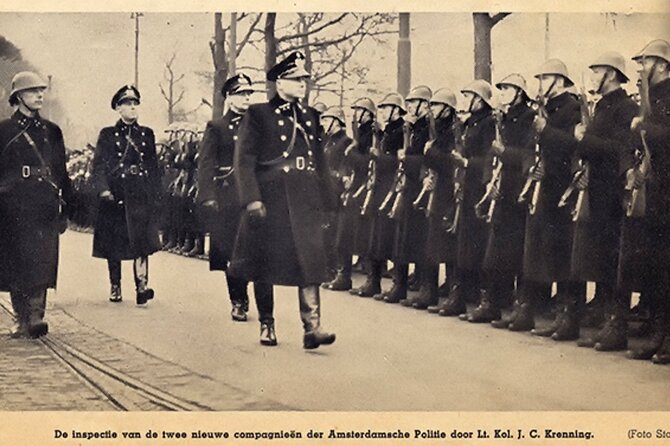
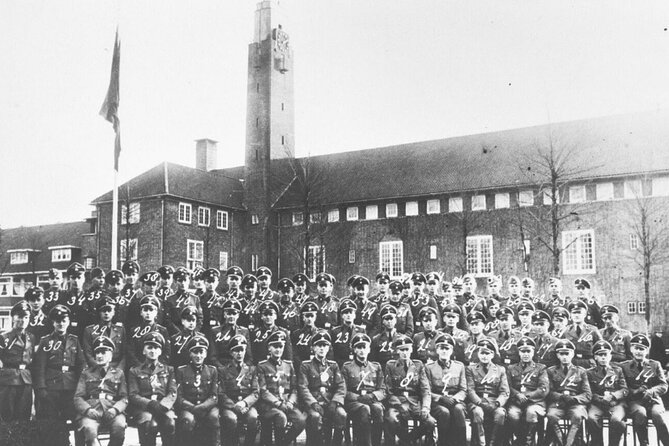
At Cornelis Troostplein 23, the tour points out the former PBA barracks. Before the war, the site was a Catholic complex with convents and a school. In spring 1942, the head of the Sicherheitsdienst, or SD, and Gestapo, Rauter, inspected the police unit and met Heinrich Himmler at Museumplein.
The change from religious and educational use to a police base makes this stop particularly revealing. It helps explain how institutions and buildings were repurposed under occupation, and how Dutch police became part of the machinery used to control the population.
Museumplein, now associated with major cultural institutions and open space, was transformed into a German stronghold during the war. Facing the Concertgebouw, buildings on the left held German offices. The former United States consulate housed the Central Jewish Emigration Office, a name that disguised its role in the persecution and deportation of Jews. Nearby were the town commandant’s office and military police, along with other Nazi offices.
On the skating club grounds, German forces built bunkers and anti-aircraft batteries. The NSB’s Amsterdam headquarters stood next to the Concertgebouw. The bunkers were blown up after the war, so the modern square does not readily reveal what once occupied it. Here the old photos matter: they help you picture a militarized space where today you might expect open lawns and cultural outings.
Resistance work and the cost of retaliation
A short stop at Café Wildschut on Roelof Hartplein provides time for coffee and a restroom visit. It is a welcome pause in a tour that deals with intense material. The stop is listed as about ten minutes, so think of it as a quick break, not a long café visit.
Near the library building on Roelof Hartstraat, a former photo shop served the Dutch resistance. It was used to develop photographs, including work by resistance photographer Charles Breijer, documenting the first roundup of Jews in Amsterdam by the SD, Gestapo, and German order police. The camera became a tool for preserving evidence, not simply recording scenes.
A nearby small monument remembers Jewish people taken from the neighborhood. The tour’s attention to modest memorials is useful because not every important site is grand or easy to identify. You may pass the marker without knowing its meaning unless someone points it out and explains the people it commemorates.
At the corner of Beethovenstraat and Apollolaan, the guide describes the execution of Herbert Oelschlägel, an SS officer and SD or Gestapo agent, by a Dutch resistance member in late October 1944. In retaliation, the SD and Gestapo burned two houses and executed 29 resistance fighters. This episode shows the terrible risks of resistance and the brutal reprisals imposed on people who had little control over the violence around them.
The street once called Euterpestraat is associated with Gerrit van der Veen, leader of an important Dutch resistance group. The route then reaches the corner of Memlingstraat and Rubensstraat, where two key Nazi organizations had offices: the SD headquarters in Amsterdam and an office that seized the possessions of deported Jews. The latter was led by Dutch collaborator Henneicke.
In November 1944, the resistance asked the Royal Air Force to attack the headquarters and destroy SD files. Group Captain Denys Gillam led the operation. Nearby, a resistance safehouse on Rubensstraat was betrayed to the SD and Gestapo by a female informant in June 1944. A Stolperstein, or stumbling stone, marks the address. These details make the neighborhood feel less like a backdrop and more like a place where clandestine work, betrayal, and military action happened in close quarters.
Olympiaplein, wartime command, and liberation
At Olympiaplein and Parnassusweg, the guide returns to the June 1943 raid. Jewish people arrested at the sports complex were registered here by the SD and Gestapo with help from Jewish camp police sent from Westerbork. The location gives the earlier account of arrests a physical setting and shows how registration formed part of the deportation process.
Valeriusplein brings the tour to the Amsterdam Lyceum, which served as Luftwaffe headquarters near the end of the occupation. At the statue of Queen Emma on Emmalaan and Prins Hendriklaan, the story shifts to a small act of defiance: in the summer of 1940, people placed flowers at the statue in protest against German occupation. Charles Breijer photographed a guard at the Kriegsmarine headquarters in 1944, another example of resistance photography preserving evidence of the period.
The final stop concerns the German surrender on May 7, 1945. Even after the surrender, tensions between German troops and resistance fighters led to dangerous confrontations. A monument marks victims of one shooting on that last day. The tour then heads through Vondelpark toward Leidseplein and the starting area.
That final stretch offers a change of pace after the heavier sites. It also makes clear that liberation was not a clean, instant switch from danger to safety. The closing story is less about celebration than about the disorder and grief that remained at the end of the occupation.
A few more Amsterdam options worth a look
- Amsterdam: Van Gogh Museum Ticket
★ 4.7 · 52,054 reviews - Amsterdam Classic Saloon Boat Cruise with Drinks and Cheese
★ 5.0 · 31,825 reviews - Amsterdam Luxury Canal Cruise + Unlimited Drinks & Bites option
★ 5.0 · 30,518 reviews - Amsterdam: Heineken Experience Ticket
★ 4.6 · 30,055 reviews
What the small group and photos add
A maximum of six people is a real advantage on a history ride. You are less likely to lose the guide’s explanations in a crowd, and there is more room to ask questions at stops. Rudy is described as a local who grew up in the area and brings family experiences into his accounts. Peter is also named as a guide, though the available details do not say which guide will lead a particular departure.
The photos are another strong feature. They are not just general images of wartime Amsterdam; they show the places you are standing in. That lets you notice what has changed and what has remained, and gives context to buildings that might otherwise look like ordinary homes or offices.
The subject matter can be grim. Arrests, deportations, executions, and collaboration are central to the route, so this is not a light sightseeing spin around town. If you want a gentler introduction to Amsterdam, choose another outing. If you want to understand the occupation through specific local stories, the detail is the reason to book.
Is $66.09 fair value for this ride?
At $66.09 per person, this costs more than a basic city bike ride, but it offers a specialist route, a guide, historical photos, and a small group. The value depends on how much you want context. If you cycle past these sites on your own, you may see the streets but miss the stories that connect them.
The tour lasts roughly two and a half to just over three hours, depending on the departure and pace. It includes a short coffee and restroom stop, but the information does not state that refreshments are included. The main return is in what you get from the guide’s interpretation, not in a long list of included extras.
One practical point needs checking before you book: the activity information does not clearly say whether a bicycle is provided, and a tour account advises bringing your bike. Contact the provider to confirm what you need to bring. Also be ready for a substantial ride through multiple neighborhoods. The group is small, but the route still calls for comfort on a bicycle.
Who should book this Amsterdam WWII tour?
I would choose this tour if you are interested in the Dutch resistance, the Holocaust in the Netherlands, or the daily geography of occupation. It works especially well if you have already seen central Amsterdam and want to understand parts of the city beyond the busiest sights.
It is also a good fit if you learn best by standing in the places being discussed. The old photographs, the local guide’s connection to the area, and the ability to cover several districts by bike make the history concrete. People with limited cycling confidence, or anyone looking for a casual scenic ride with only a little history, may prefer a different activity.
Book it for the local detail and carefully chosen stops, not because you expect a relaxed sightseeing loop. If you are comfortable cycling and want an informed, place-based account of Amsterdam under occupation, this is a strong use of a morning.
FAQ
How long does the tour last?
The tour takes approximately two hours and 30 minutes to three hours and 10 minutes. It includes a short stop at Café Wildschut.
What time does it start?
The listed start time is 11:00 am.
Where does the tour begin?
The meeting point is Tesselschadestraat 1, 1054 ET Amsterdam. The route description begins at Victorieplein and returns to the starting area.
Where does the tour end?
The activity ends back at the meeting point. After the final historical stop, the route goes through Vondelpark toward Leidseplein.
What language is the tour offered in?
The tour is offered in English.
How many people can join?
The maximum group size is six people.
Is a bicycle included?
The available details do not clearly confirm whether a bicycle is supplied. One account advises bringing a bike, so check with the provider before booking.
What does the tour cost?
The listed price is $66.09 per person.
Can I cancel for a refund?
Yes. You can cancel at least 24 hours before the start time for a full refund. Cancellations made less than 24 hours before the tour are not refunded.
Added lately in Amsterdam
- Nemo Science Museum Admission★ 5.0 · 4 reviews
- Off the Beaten Paths Dutch Landscape Private Tour 1/2 day Jaguar★ 5.0 · 10 reviews
- Northern Highlights Tour: visit 4 magnificent places from Amsterdam★ 5.0 · 5 reviews
- Off the beaten paths Dutch Country Side Private Tour in Jaguar★ 5.0 · 5 reviews
- From Amsterdam: Day Trip to Rotterdam, Delft & Hague with Cruise★ 3.0 · 15 reviews
- Amsterdam : Keukenhof FlowerFarm Privatetour Skip-The-Line ticket★ 5.0 · 33 reviews
- NEMO Science Museum Amsterdam Admission Ticket★ 4.5 · 36 reviews
- Amsterdam Light Festival: Canal Cruise + Bite & Unlimited Drinks★ 4.5 · 20 reviews
Amsterdam Jewish History Tours, compared.
Life of Anne Frank and World War II Walking Tour
Read our review →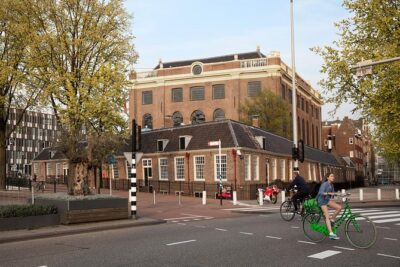
Anne Frank Walking Tour Amsterdam Including Jewish Cultural Quarter
Read our review →
Anne Frank and Jewish Quarter Amsterdam Private Walking Tour
Read our review →
Anne Frank and Jewish Quarter Walking Tour (TOP RATED)
Read our review →
Browse the lists this tour appears in